
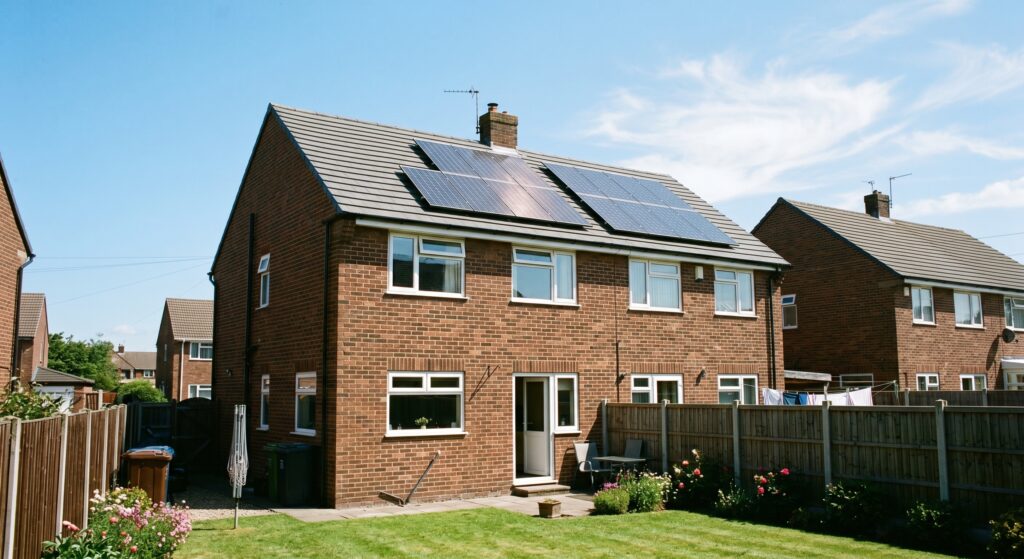
Key takeaways
- A 4 kWp solar system costs £5,500–£7,500 installed in the UK in 2026 (0% VAT) — roughly 30% cheaper than five years ago.
- Without a battery, expect £600–£800 annual savings and a 7–10 year payback on a south-facing roof.
- With a 5 kWh battery (£10,000–£12,000 total install), savings rise to £800–£1,000/year, but payback extends to 11–13 years.
- The single biggest variable isn’t your panels — it’s your SEG export tariff. Octopus Outgoing pays 15p/kWh; the worst payers offer under 5p. That’s £200+/year on the same panels.
- Solar pays back fastest for homes with high daytime electricity use (working from home, EVs, heat pumps) on a south or south-east-facing roof.
The short answer: yes, for most UK homes — but not all
Solar panels are still worth it in the UK in 2026 for the majority of homeowners with a suitable roof. A typical 4 kWp system on a south-facing roof in central England costs around £6,500 installed, generates roughly 3,400–3,600 kWh per year, and delivers £600–£800 in combined savings and export income annually — paying for itself in 7 to 10 years and continuing to generate near-free electricity for another 15+ years after that.
The picture is less rosy in three specific cases: north-facing or heavily shaded roofs, homes with very low daytime electricity use, and households who finance the install on high-interest credit. We’ll cover each of those properly below.
A note on how I write about this. I’m an architect, not an MCS installer or a financial adviser. What I bring to the topic is the building-fabric side — how homes actually work as thermal systems, what an installer’s quote really means, and where the marketing language drifts from the engineering reality. For the financial and regulatory specifics — current SEG rates, grant eligibility, Ofgem price cap figures — I cite primary sources directly so you can verify them yourself.
[image showing a side-by-side comparison: a sunny south-facing roof vs a shaded north-facing roof — diagram, not photograph]
What does a solar panel system cost in the UK in 2026?
A typical 4 kWp solar PV system costs £5,500 to £7,500 fully installed in the UK in 2026, including panels, inverter, mounting hardware, electrical work, scaffolding, DNO notification, and MCS certification. VAT is 0% on residential solar installations in the UK until at least March 2027.
Here’s the current price spread by system size, based on a sample of MCS-certified installer quotes across the UK:
[table showing system sizes, panel counts, install costs, and typical homes]
| System size | Panels (typical) | Install cost (median) | Suits |
|---|---|---|---|
| 2 kWp | 5 panels | £3,200–£4,500 | 1–2 bed flat / small home |
| 3 kWp | 8 panels | £4,500–£6,000 | 2-bed terrace |
| 4 kWp | 10 panels | £5,500–£7,500 | 3-bed semi (most common) |
| 6 kWp | 15 panels | £8,000–£11,000 | 4-bed detached |
| 8 kWp | 20 panels | £10,500–£13,500 | Large detached, EV + heat pump |
| 10 kWp | 25 panels | £13,000–£16,500 | Large home or rural off-grid plans |
Prices have fallen roughly 30% since 2021. A 4 kWp system that cost £8,000–£10,000 in 2019 now sits in the £5,500–£7,500 range. Most of that drop comes from cheaper panels manufactured in China — installation labour and scaffolding costs have actually risen slightly over the same period.
What drives a quote up
From an architect’s perspective, three things consistently push a quote toward the top of the range — and only one of them is really about the panels:
- Roof complexity — multiple pitches, dormers, skylights, fragile clay tiles, or non-standard rafter spacing all add labour and scaffolding time. Most quote variation comes from here, not from the panels themselves.
- Premium panels — high-efficiency monocrystalline or all-black panels add £500–£1,500 versus standard units. The output difference is usually under 8%. Worth it for aesthetic reasons on a visible front roof; not worth it for performance alone.
- Hybrid inverter — a hybrid (battery-ready) inverter costs £400–£800 more than a standard string inverter. Worth it if you plan to add a battery within 3 years; not worth it otherwise.
[image showing a labelled diagram of a typical UK solar PV install — panels, inverter, consumer unit, smart meter, grid connection]
<a id=”savings”></a>
How much will you actually save?
Your real savings depend on three numbers:
- How much electricity your panels generate (mostly a function of system size, roof orientation, and pitch)
- How much of that you use yourself — your self-consumption rate
- How much you’re paid for what you export — your SEG tariff
Here’s a worked example for a typical UK household — the kind we see most often when people use our Solar Sizing Calculator:
Household: 3-bed semi, Midlands, south-facing roof, two adults working from home 3 days/week System: 4 kWp, no battery Annual generation: ~3,500 kWh Self-consumption rate: 40% Electricity import price: 24.3p/kWh (Ofgem Q2 2026 price cap) SEG export rate: 12p/kWh (Octopus Outgoing fixed)
Savings from electricity you don’t have to buy: 3,500 × 40% × £0.243 = £340/year Income from electricity you export: 3,500 × 60% × £0.12 = £252/year Total annual benefit: £592/year
[image showing a chart: stacked bar showing self-consumption savings vs SEG export income for 4 kWp system, with and without battery]
That’s a conservative figure. Three things can push it meaningfully higher:
- Better self-consumption. Running the dishwasher, washing machine, and EV charging during peak generation hours (10am–4pm) lifts self-consumption from 40% to 55–60% with no battery at all.
- A higher SEG rate. We’ll get to this below — the gap between best and worst SEG tariffs is enormous.
- Future electricity price rises. Most credible forecasts have UK retail electricity at 27–30p/kWh by 2030. I deliberately don’t price that into payback maths because forecasts are forecasts — but it’s a tailwind, not a headwind.
<a id=”payback”></a>
The honest payback maths
[image showing a line chart: cumulative savings over 25 years, three scenarios — no battery, with battery, with battery + heat pump/EV — showing crossover points]
Using the figures above, here’s how the payback shakes out across three realistic scenarios:
| Scenario | Install cost | Annual benefit | Payback | 25-yr profit (after £1,500 inverter swap) |
|---|---|---|---|---|
| 4 kWp, no battery, 40% self-consumption | £6,500 | £590 | 11 years | £6,250 |
| 4 kWp + 5 kWh battery, 75% self-consumption | £10,500 | £820 | 12.8 years | £7,500 |
| 4 kWp + battery + EV/heat pump (high daytime use) | £10,500 | £1,050 | 10 years | £14,750 |
A few things to flag:
- These figures assume current 2026 electricity prices held flat for 25 years. They almost certainly won’t — but pricing in increases would make me look optimistic, not honest.
- I’ve included a £1,500 inverter replacement at year 12. String inverters typically last 10–15 years.
- Panels degrade slowly — about 0.5% per year — so year-25 output is roughly 88% of year-1 output.
- I’ve not included panel cleaning (£100 every 2–3 years for most homes — UK rain does most of the work).
For your specific home, run the numbers in our Solar Sizing Calculator — it uses your postcode, roof orientation, and current bill to give a tailored figure rather than a national average.
<a id=”battery”></a>
Should you add a battery?
Maybe. The honest answer is “it depends on when you use electricity,” and it’s the question I get asked most.
A 5 kWh battery typically costs £3,000–£4,500 added to a solar install, or £4,500–£6,000 retrofitted to an existing system. It works by storing surplus solar generation during the day and releasing it in the evening when you’d otherwise be importing from the grid at 24.3p/kWh.
[image showing a daily usage chart: typical UK household showing solar generation peak at midday, demand peak at 6-9pm, and how a battery shifts the surplus]
When a battery makes financial sense
- You’re out during the day. If most of your electricity demand happens after 5pm, a battery captures generation that would otherwise be exported at 12p/kWh and lets you use it at the equivalent of 24p/kWh. That’s effectively a 100% return on each stored kWh.
- You’re on a time-of-use tariff. With Octopus Go or Intelligent Octopus, you can also charge the battery from the grid at 7p/kWh overnight and use it during peak hours — a separate saving on top of solar.
- You have or plan to have an EV or heat pump. The combined load makes the battery work harder.
When a battery doesn’t pay back
- You work from home. If you’re around 9–5 and naturally use electricity as it’s generated, you’re already self-consuming 60%+ without a battery. The marginal benefit is small.
- You want it for backup power. Most standard batteries don’t provide blackout backup unless specifically configured (and that costs more). Be clear about why you’re buying it.
Bottom line: add a battery if it shortens your payback or matches your usage pattern — not because it feels more “complete.” For roughly 40% of households we model, the battery doesn’t justify the cost on financial grounds alone.
<a id=”seg”></a>
The Smart Export Guarantee — the lever most homeowners ignore
The Smart Export Guarantee (SEG) is a legal requirement that all UK electricity suppliers with 150,000+ customers offer a tariff paying you for solar electricity you export to the grid. Most homeowners accept whatever rate their import supplier offers and never look again.
That’s leaving money on the table. The gap between the best and worst SEG rates in 2026 is roughly 12p/kWh — on a typical 1,800 kWh annual export, that’s £216/year swinging on which paperwork you signed.
Here’s the current state of the market (rates as of April 2026):
| Supplier | SEG tariff | Rate | Tied to import? |
|---|---|---|---|
| Octopus Energy | Outgoing Octopus (fixed) | 15p/kWh | No |
| OVO Energy | OVO SEG | 12p/kWh | No |
| E.ON Next | Next Export Exclusive | 16.5p/kWh | Yes |
| Scottish Power | Smart Export | 12p/kWh | Yes |
| British Gas | Export & Earn Flex | 6.4p/kWh | No |
| EDF | Export+ | 5.6p/kWh | No |
[image showing a bar chart ranking SEG tariff rates from highest to lowest, colour-coded by whether tied to import]
A few things worth knowing:
- You can have different suppliers for import and export. Your import MPAN (what you buy) and export MPAN (what you sell) can be with different companies. This surprises most people, but it’s standard.
- You need a SMETS2 smart meter capable of recording export. Most installs since 2020 have one.
- You need MCS certification of your install. Without it, no SEG tariff will accept you.
- Switching takes 2–4 weeks and is essentially free admin.
If you’ve had solar for more than a year and haven’t reviewed your SEG tariff, do it today. For a deeper comparison see our SEG tariff comparison guide.
<a id=”not-worth-it”></a>
When solar isn’t worth it
I don’t make money by recommending solar to people for whom it doesn’t make sense. There are three situations where I’d tell you not to bother:
1. North-facing or heavily shaded roofs
A north-facing roof generates roughly 40% less than a south-facing one of the same size. East and west aren’t bad — they generate about 85% of south-facing — but anything with significant shading from trees, chimneys, or neighbouring buildings during peak hours (10am–4pm) takes a serious hit.
This is one area where the architect’s eye genuinely helps. I’d encourage anyone seriously considering solar to spend a sunny day photographing their roof from ground level at 10am, 1pm, and 3pm. If significant shadow lines fall across the proposed panel area in any of those, mention it explicitly to your installer and ask for a shading-adjusted generation estimate — not the headline figure.
If your only available roof space is north-facing, payback typically extends to 15+ years, and you should consider whether the money is better spent on insulation first.
2. Very low daytime electricity use
If you’re out of the house Monday to Friday, don’t have an EV, don’t have a heat pump, and your evening usage is modest, your self-consumption rate sits around 25–30%. Most of what you generate gets exported at 12p/kWh rather than displacing 24p/kWh imports — which roughly halves the per-kWh value of your panels.
This is the case where a battery genuinely changes the maths, but it also extends payback into the 13–15 year range.
3. You’d be financing it on high-interest credit
Solar pays back at roughly 8–10% per year as an investment. If you’re financing the install on a credit card or personal loan at 12%+, you’re losing money each year. Wait, save, or use lower-cost finance (some installers now offer 0% APR over 5 years; mortgage extensions sit around 5–6%).
[image showing a flowchart: “Is solar worth it for me?” decision tree — roof orientation, daytime usage, finance availability]
<a id=”grants”></a>
Grants and 0% VAT
There is currently no direct capital grant for solar panels in England in 2026 for most households. The Feed-in Tariff closed to new applicants in 2019 and was replaced by the SEG, which is an income stream rather than an upfront subsidy.
What you do get:
- 0% VAT on residential solar installations until 31 March 2027 — saving £1,100–£1,500 on a typical install. Source: HMRC Notice 708/6.
- ECO4 / Great British Insulation Scheme doesn’t fund solar directly, but covers insulation that improves your overall energy economics.
- Local authority schemes vary — some councils offer interest-free loans or partial grants for low-income households. Check your postcode in our Grant Checker.
- Means-tested schemes (some areas) can fund full solar installs for households under £36,000 income — eligibility varies dramatically by council.
For full details on every grant currently active, see our grants overview.
<a id=”faq”></a>
Frequently asked questions
How long do solar panels last in the UK? Most panels carry a 25-year performance warranty guaranteeing at least 80–85% of original output by year 25. Real-world degradation is typically 0.4–0.5% per year. Inverters need replacing every 10–15 years (£1,000–£1,500). The actual panels often run 30+ years before failure.
Do solar panels work in cloudy UK weather? Yes — panels generate electricity from daylight, not direct sunshine. Cloudy days produce 30–60% of full output. The UK gets about 30–40% as much annual sunshine as Spain, but solar still pays back because of high electricity prices and 0% VAT.
Do I need planning permission for solar panels? For most UK homes, no — solar PV is permitted development provided panels don’t extend more than 200mm from the roof slope and don’t sit higher than the highest part of the roof. Listed buildings, conservation areas, and flats are the main exceptions. Always check with your local authority.
Can I install solar myself to save money? Technically yes for off-grid systems; practically no for grid-connected installs. Without MCS certification you cannot claim any SEG tariff, you may invalidate your home insurance, and DNO notification becomes complicated. The £1,500–£2,000 you’d save isn’t worth losing £200+/year of SEG income for 25 years.
What’s the best SEG tariff in 2026? Octopus Outgoing (15p/kWh fixed) is the highest rate currently available without import tying. E.ON Next Export Exclusive pays 16.5p but only if you also take their import tariff. For most households, Octopus Outgoing is the best combination of rate and flexibility.
Will solar panels damage my roof? A properly installed system shouldn’t, and modern mounting systems often protect the underlying tiles from weather. From a building-fabric perspective, the things to watch are flashing detail around penetrations, fixing into rafters (not battens), and that the roof structure can take the additional dead load — typically 12–15 kg/m² for panels plus mounting. Use an MCS-certified installer with public liability insurance and ask for the warranty terms in writing.
How long does installation take? A standard 4 kWp install takes 1–2 days on the roof, plus another half-day for electrical work and commissioning. From signed contract to commissioning is typically 4–8 weeks, mostly waiting for DNO approval.
Can I add a battery later? Yes — but ask your installer to fit a hybrid (battery-ready) inverter at install if you think you might. Retrofitting a separate AC-coupled battery later costs £500–£1,000 more than including it from the start.
So, is solar worth it for you?
For most UK homeowners with a south, east, or west-facing roof and any meaningful daytime electricity use, yes — solar still pays back. The economics are less spectacular than during the Feed-in Tariff era, but cheaper panels, 0% VAT, higher SEG rates, and rising electricity prices have kept payback in the 7–11 year range for typical homes.
The honest test is this: would you spend £6,500 today to lock in £600+/year of energy savings for 25 years, with most of that as protection against future price rises? For most people, the answer is yes. For people on north-facing roofs, with very low daytime usage, or who’d need to finance it expensively, the answer is “not yet — wait or do other things first.”
Run your specific numbers in our Solar Sizing Calculator, or get 3 fixed-price quotes from MCS-certified local installers via our installer-finder.
Sources
- Ofgem Energy Price Cap, Q2 2026 — used for 24.3p/kWh import rate
- Smart Export Guarantee — Ofgem — for SEG framework and supplier obligations
- VAT on Energy-Saving Materials — HMRC Notice 708/6 — for 0% VAT on solar
- MCS Certified Installations Database — for installation pricing benchmarks and installer standards
- Energy Saving Trust — Solar Panels — for technology guidance and savings methodology